War Time Memories is a blog dedicated to detailing the Second World War from those who experienced it first hand. Each individual featured on this blog has been interviewed by me personally, as my goal is to record the stories of the veterans (and civilians) who are still with us today. Regardless of whether they were fighting for the Allied or the Axis powers, I desire to give my readers an in depth look at WWII from all sides.
Showing posts with label wwii wartime memories. Show all posts
Showing posts with label wwii wartime memories. Show all posts
Eldon Olin, better known as Ole, was
born on 23 March 1921 in Chinook, Washington to John and Ellen Olin. He had
eight brothers and sisters, three of which were half-siblings. His father died
when Ole was about nine years old and in an effort to help his mother
financially, he retained a job delivering telegrams for the Postal Telegraph
Company.
Cover of a CCC manual
Ole’s family was one of many across America who was deeply affected by
the Great Depression which hit in 1929. He quit school after the 8th
grade and upon turning 16 Ole joined the Civilian Conservation Corps (CCC). He
was initially tasked with felling trees in the Oakridge area for $1 a day. Later on he served as a sign painter as well as an axe man with the survey
team. Ole inherited his father’s love of painting and after saving up for a
while, purchased a beginners oil painting set for $4. He later sold his first
painting for $5 and thus his free-time art career began.
Bunny & Ole on a motorbike 1942
In late 1939 Ole gained employment with
the Hinkson Timber Cruising Company in Eugene, Oregon. He started at the bottom
and ended up learning how to perform the variety of tasks performed on a timber
cruise. While attending his sister Elva’s 15th birthday party
(1940), Ole met his future wife Bernice “Bunny” Eversole. The two eloped (Bunny
was 17 1/2) and were married in Toledo, Oregon on 9 June 1942. In the summer of
1942, Ole was working as a Compassman on a timber cruise out of Eugene. In
August of that year, while on a job just East of Seattle, Washington, Ole received
a telegram from his wife urging him to head home straight away. Ole was being
drafted and was to report immediately to Fort Lewis. From that moment forward
their lives were forever changed. Ole officially entered the service on 10
September 1942 at the age of 21 and went through basic training at Camp Crowder
in Missouri, as well as Message Center School.
Louisiana Maneuvers
He was then sent on to Camp
McCain in Mississippi for further training and after that he participated in
maneuvers at Camp Polk, Louisiana. His young bride made her way to Camp McCain in January of 1943 with the desire to spend as much time as possible with her husband before he was shipped off to war. Bunny managed to find them a room to live in, which included an old leather sofa for a bed and use of the bathroom. She also found a job at the local drugstore where she worked as a waitress. Whenever Ole was on leave he spent it with his wife. In April of that same year, the couple found out they were expecting. Bunny was quite homesick by this point so Ole, able to get a pass, took her back to Oregon by way of train.
Ole was soon sent on to Camp Van Dorn
(also in Mississippi) for mobilization training then to Camp Polk, Louisiana. He
was in the Signal Corps and was given the job of telephone lineman. This
required him to spend ~10 weeks learning to build open wire lines and lay field
wire. On 30 November 1943 his first child, Michael, was born. At the beginning
of December Ole traveled back to a couple of the Camp’s he had previously been
to, receiving training for overseas deployment.
H.M.S. Andes
In late December he was given leave to see his
newborn child. Unfortunately, traveling by train from the South to Oregon was slow
going and most of his leave was spent on a train. But the excitement of being a
new father kept his spirits high and he was grateful for the precious little
time he had to hold his son before heading off to war. On 31 January 1944,
Company B of the 33rd Signal Construction Battalion began making
their way to New York where they would board the H.M.S. Andes.
On
9 February they departed from the United States and arrived ten days later in
Liverpool, England. From there it was on to Wrexham, Wales by train to receive
training on mine detection & clearing, unarmed defense, and so forth. While
there Ole stayed in an old castle. He attended gunnery school as well in
Scotland. After this training they headed to London and then crossed the
English Channel, landing on Utah beach in Normandy on 12 July. When Ole first
entered France the 33rd was under the 2nd Army but soon
moved to the 3rd under General Patton.
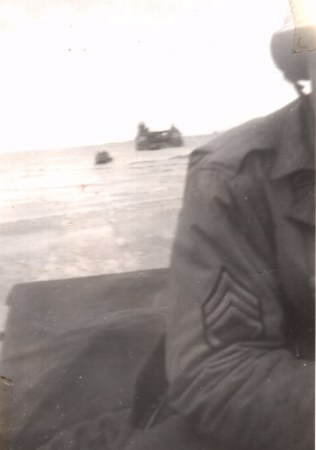
Coming Ashore at Normandy - Ole's Private Collection
The Company was divided into squads of
eight men placed on detached service and scattered across Europe. Initially,
lines were hung from wooden poles. However this method was abolished as they
were easily seen and destroyed by the enemy. Lines were thereafter laid along
the ground and camouflaged with brush. Sometimes the lines even had to be run
across rivers.
A typical day for Ole started with
washing up by putting water in his helmet and then eating his breakfast
rations. The squad would then crowd around their Sergeant and receive their
orders for the day.
Ole with his M-1
Being a lineman on the battlefield was no easy task and
being shot at was a very real concern as they were often in enemy territory. The
men would rotate which one was 1st , 2nd , 3rd
, etc. Ole was among those who came under fire while on the job. The men always
had to be on guard and they stayed with the job until it was finished, even
when it meant staying overnight in enemy territory. Ole carried a .30 Cal. M-1
on him and a Thompson Sub-machine gun was kept in the truck.
.30 Caliber M-1
Thompson Sub-Machine Gun being Demonstrated by a British Cpl.
Ole’s job included
determining where telegraph or telephone wire would be laid, laying the line,
maintaining them, and performing any repairs. Once a job was completed, they headed
back to the bivouac area in their truck(s), ate their dinner rations, and
grabbed some shut-eye. Canned rations, that Ole sometimes had, included ham
& eggs, hash, cooked potatoes, and fruit. Fruit was less common and was a
real treat for the men when it was available. When it came to sleeping, the men
would round up whatever bedding materials they could from old mattresses to blankets.
Such “luxuries” quickly came to an end when they procured lice infested bedding
which led to them all being given some sort of salve by the medics to kill the
lice.
Mail call…..nothing compared to letters
and packages from home. When the mail would finally catch up (after going through
the hands of censors, travelling thousands of miles, and criss crossing its way
across Europe) to Ole and the others, each and every one hoped to hear their
name called. “I was thrilled and so were all my buddies (about receiving post).
Even little French and Luxembourg children would hang around. We would share
like a third of a Butterfinger to three kids and such,” Ole said of mail call
during the war. The locals were always very appreciative of anything Ole and
his buddies gave them, whether it was a cigarette to an old man or a piece of
candy to a little girl. He went on to say that his wife Bunny sent him many
Gumdrop cakes, cookies, and candy; which he would generously share with his
buddies.
Mail Call at unknown location with unknown men
News from home was about the only “news”
Ole and his buddies got, except for the occasional radio they would come across
in an abandoned house. Ole recalled that he and the guys loved it if they could
tune into music or the BBC. In his free time, Ole loved to sketch and paint. He
even managed to paint a picture of his wife (from a photograph) onto the canvas
of a German machine gun cover while on the Brest peninsula in France.
A sketch of Ole's wife Bunny, drawn by him during the war
When
Company B was close to the German border, Ole witnessed a buzz bomb launched.
Then on Thanksgiving Day 1944, he and his buddies stood in the chow line
anxiously awaiting a celebratory meal. Unfortunately, their plans were
disrupted when German planes strafed the group of men. Ole was second to last
in line with his Captain directly behind him when the event occurred. As the
planes came down the street, everyone ducked inside a building. Thankfully no
one was injured. Like many husbands and fathers who were in the military, Ole
worried about returning home to take care of the family he had just begun.
Getting home was always on the forefront of the telephone lineman’s mind. Ole's outfit went into Germany during the Battle of the Bulge. He witnessed at least one of the concentration camps and the liberation of the camp.
Braving The Cold For Communication
L to R Eldon Olin, Sgt. Slacker, Charles Stewart) - Frank Marks Collection
On 10 February 1945 Lieutenant General
George S. Patton, Jr., Commander of the U.S. Army, commended every officer and
man of the Third Army Signal units for “the superior manner in which his tasks
have been performed.” Also according to
the commendation letter, the men “in spite of an unprecedented change of direction,
and in the minimum of time, the men maintained the signal communication of the
Army at a time when signal communications were more than usually vital, and
under conditions of weather and enemy action particularly difficult.”
"Baker" Company Marching in England (Ole's Collection)
Later on 26 June 1945, the 33rd
Signal Construction Battalion was the direct target of a commendation from
Colonel Elton F. Hammond, Signal Corps Signal Officer, for their outstanding
performance in the France, Luxembourg, and Germany campaigns. In it Col.
Hammond states that he had desired to commend the men of this Unit in person.
However, he was unable to meet up with them before their departure from the
area they were in at the time. In the letter the Colonel states, “The best
measure of success of your organization in accomplishing this difficult
assignment is the fact that despite frequent and unpredictable changes in
Corps’ command post locations, this headquarters was never without adequate
wire communication to its subordinate Corps. It is well known that the establishment
and maintenance of these all-important wire communication facilities could only
be accomplished by the loyal, hardworking, and extreme devotion to duty of
every member of your organization. The successful accomplishment of your
missions contributed materially to the successful operation of the Third U.S.
Army in one of the most outstanding military campaigns in modern history.”
While in Luxembourg-Merl, Ole and his
buddies stayed in the “Beim Wooner” (At The Carriage Builder’s”) tavern for a
bit. The business was owned by Jean Pierre and Rosalie Laroche-Gaviny.
The tavern Ole and his buddies stayed in while in Luxembourg-Merl
Ole's Painting of "Susie"
Rosalie
had noticed the talented artist drawing his buddies to pass the time. One day
she asked Ole if he would please do a drawing of her daughter Suzanne (called
Susie by the G.I.’s). He asked his commanding officer thinking he the answer
would be a firm no. Much to his surprise the CO agreed, saying it was the least
they could do to repay the family’s kindness. (*Note: The tavern is still
around today but is now known as “Café De L’arret” (Bus-Stop Tavern).
“Café De L’arret” (Bus-Stop Tavern)
Ole was still
in Germany when the country surrendered on 8 May 1945. Everyone was beyond
excited for Victory in Europe (VE) Day….this part of the war was over. His platoon visited Munich and went into Austria while making their way out of Europe. Ole had
acquired enough service points to head home but he was sent on to the Pacific
Theater. While in route, Japan surrendered and no longer would Ole have to
worry about the Axis Forces. He did have to spend two months in the Philippines
though. According to Ole, he and the others spent them drinking beer, eating
coconuts, and laying on the beach. They had certainly earned it.
2nd Plat. Co. B 33rd Signal Construction Battalion in the Phillipines
He ended up
transferring out of his outfit into the Buckeye Division of Ohio and shipped
out at the beginning of December 1945, arriving in San Francisco on 11 December.
He hopped onto another boat that took him to Tacoma, Washington where he
reported to Ft. Lewis. Three days later he was discharged with the rank of Corporal.
Company B with some of their war booty (L-R Elmer A. Bokamper, Joseph LaBarbera, Charlie Seelenger, Charlie Stewart, Ray Martin)
Ole served in the Normandy, Northern
France, Ardennes, Rhineland, and Central Europe campaign’s in over nearly a
year’s time. His decorations and citations include the Good Conduct Medal,
Victory Medal, American Theater Service Medal, European African Middle Eastern
Service Medal, and the Asiatic Pacific Service Medal. Ole passed away on 27 March
2014, obviously before he could see his war story published on this blog. Thankfully
he was able to visit the National WWII Memorial in Washington D.C. in October
of 2012 thanks to their local chapter of Honor
Flight. Ole described his involvement in the Second World War as “the worst
time of my life.” At the wars’ end he suffered from “battle fatigue” and hoped
that those who read his story will do all they can to prevent such an event
taking place again.
"Monday Morning" Painting by Ole
He went on to obtain his pilot’s license
in 1948 and to have a second son, Greg, on 11 June of that same year. Using this new skill and his experience in the timber industry, Ole
ended up creating a career as a self-proclaimed “tree detective”, providing clients
with aerial photographs of their land. Ole was one of many who helped bring
aerial photography into the civilian world, proving to clients that the
photographs contained a wealth of information pertinent to their business. He
and Bunny had their third child, a daughter named Bonnie Jo, in February of 1951. Ole continued to
paint in his free time, often using his timber career as the subject matter. Getting his hands on proper supplies once the end of the war brought him back stateside, allowed the true depth of his talent to show. To
view or purchase Ole’s work, visit www.eldonolin.com.
In order to help preserve the history of the telephone lineman and the 33rd signal Construction Battalion as a whole, Ole donated his personal collection of photographs he had taken during the war to a 33rd S.C.B. reenactors group out of New Jersey. You can find them on the web at 33rdscb.tripod.com or on Facebook. (**NOTE: Any photographs that do not give credit to anyone in particular came from the author's research on the internet)
As always, comments on the war stories, requests for your war story to be written, or anything else are greatly appreciated. IF you request that I respond to your comment please leave your email address. If you prefer to contact me directly, email me at aengleford@gmail.com and note WWII Blog in the subject line. Thanks for visiting the blog.
C.G. Cooper was born on 11 July 1923 in
Lafayette, Tennessee. C.G. decided to leave home after graduating high school
to wander America. He ended up becoming a welder at Kaiser Shipyards in
California. The draft board finally caught up with him and on 28 June 1943,
just shy of his 20th birthday, C.G. was inducted into the United
States Army Air Force. He went through basic training at Camp Lee, Virginia and
when asked by the Army what he wanted to do, C.G. basically said ‘anything but
cooking’. Needless to say, C.G. wasn’t laughing when he was told that he’d be
designated as a cook and would go through Bakery & Cook School. He graduated
from Bakery & Cook School as a 1st cook and told he would be
behind the front lines with plenty of food and warmth and placed in Company E,
289th Infantry, 75th Division.
C.G. Cooper - Age 21
C.G.
was supposed to be quartermaster but because of his excellent marksmanship and
the need for more men to fight the elite German forces wreaking havoc on the
European front, was chosen to be on the frontlines as a rifleman. Wherever his
company went, C.G. was either fighting alongside them or cooking food for them.
C.G. received further training at Camp Breckinridge, Kentucky and went overseas
from there. He recalled when they gave the 1st cook position to
another guy who knew nothing about cooking, much less for an army of men! The
new guy asked C.G. the proper amount of beans to prepare for all the men. C.G.
told him to figure it out since he was now the cook and especially since he was
receiving sergeant pay (C.G. was a Pfc).
The sergeant cook,
as I will call him, made 17 pounds of beans for approximately 250 men, when
only 7 pounds were needed! Beans, beans, and more beans! The company of men the
sergeant cook prepared them for were none too happy with his lack of portion
control, as they had to eat them for every meal over the days that followed
until every last bean was gone! This was due to the fact that the food was
considered Army property and improper disposal of Army property could lead to
being court-martialed!
Around
this same time period, C.G.’s wife Patricia who was back in Knoxville,
Tennessee, was about to give birth. She was a very small lady and the doctor
was concerned that she might have difficulty during the delivery. Like any
concerned husband and soon to be papa, C.G. wanted to be with her. He was told
that if he left he would be court-martialed. This warning did not deter him.
Instead, C.G. made his way to the Red Cross and asked permission to go telling
them that if they denied his request he would climb the walls and go anyway.
The
phone rang and it was the doctor in Knoxville saying that C.G. needed to come
immediately. They finally gave him permission and he began his trek by hitch
hiking. At one point he was stranded in the rain. Thankfully someone stopped
and offered him ride. Unfortunately the vehicle was a motorbike. C.G.’s brother
had been killed while riding one so he was a bit apprehensive. He ended up
accepting the offer however. He got off in Nashville where his father lived and
then caught a bus on to Knoxville. C.G. was supposed to be back on the base
that Sunday, but decided to stay in order to hold his baby in his arms. (All had
gone well with the delivery.) Of his decision to stay he said, “I didn’t know
if I’d live to ever see him again or not.”
On
Monday he got orders to go to HQ as he was considered to be AWOL. C.G.’s
service record indicates his one AWOL, but it was a decision he never
regretted. His son was two weeks old when he left for the battlefields from New
York on 22 Oct 1944. His ship arrived at in Liverpool, England on 3 Nov 1944. The
men then traveled on to South Wales and finally crossed the channel to France.
Once on French ground the men headed to Paris where C.G. says they were treated
like heroes. Then it was on to Bastogne, Belgium where they spent their first
night in battle with the enemy. This brutal battle would become known as The
Battle of the Bulge.
Despite
the area having its coldest winters on record up to that time, Allied leaders
chose not to send appropriate winter clothing with C.G. and the other men,
saying that they would only be involved in a few skirmishes. These leaders were
wrong and their decision could have spelled disaster for the Allies.
Fortunately our men pulled through like the troopers they are. The men were
given C and K rations so there would be no need for cooks on the frontlines.
C.G. was put in charge of guarding the kitchen and ammo truck on the first
night while the other men were enthralled in battle. The driver of a jeep came
up to him saying that a German tank was headed his way and not to let it
through.
“What
will I do?” C.G. remembers thinking back then. Ideas began swirling in his
mind….the .45 pistol on his hip…his rifle. He grabbed a carbine, machine gun,
bazooka, grenades, and ammo belts from the truck he was guarding. “I was a
walking arsenal”, he said. The ideas continued in his mind…a grenade…no, that
won’t work…a Molotov cocktail…no, that won’t work…blast it with a bazooka (he
recalled watching a training film that showed a bazooka being used to blast the
tracks off a tank)…no, I have no ammo for it. At this point, the tank is right
in front of him and his mind is frozen. In the chaos, C.G. slipped falling in
the tanks’ path due to the slick mud. Providence was with him as the tank
rolled right over him, straddling him and continuing on its path.
The
next morning he found out that some of his buddies had been killed. C.G. said
it was a gruesome sight, the bodies strewn about the battlefield. The Germans
had succeeded in surrounding them and they were now cut off from replacements
and supplies. C.G. ate dry hog bran from a farm and was happy with that
discovery. He also managed to find a turnip in the root cellar. Another group
of the Allies eventually pushed the Germans back and rescued the previously
surrounded men. They regrouped and received replacements, some of whom were
only teenagers. On Christmas Eve and Christmas Day 1944, a heavy snow had
covered everything and C.G. said it was a beautiful sight to behold. Suddenly
all heck broke loose with dogfights in the sky and heavy artillery shelling on
the ground. He never forgot that Christmas Day.
At one point,
C.G. was sent to the hospital due to his frostbitten toes. This was a common
occurrence with the lack of appropriate clothing for the extreme weather
conditions. While lying in his hospital bed, the soldier on one side said to
the soldier on C.G.’s other side, ‘Joe*, I’m dying. Tell my folks how much I
love them.’ C.G. later found out that the two men had fought alongside the
Russians who had given them poisoned liquor for some reason. (*After a while,
soldiers would call one another Joe because by the time you learned someone’s
name, it seemed you died or they did.) The
soldier who asked his buddy to give the message to his parents, died later that
day and his buddy soon suffered the same fate, blind and calling out for loved
ones.
That same
morning, soldiers were lined up to be seen by the doctor. Many of the men were
there for frostbite and the doctor told most that the affected appendages
needed to be amputated. When it was his turn, C.G. put his hand up to jaw and
moaned. The doctor asked what was wrong with him and he said he had a
toothache. The doc told him that he was in the wrong line and off C.G. went. He
remembers thinking, “I came over here with all my body parts and IF I get to go home, I wanna go home
with all my body parts…all together.”
From the
hospital he hitchhiked back to his outfit. He went to the kitchen truck and
told his company commander that he had been on the front lines and knew what it
was like. “If you’ll give me permission to have a truck and driver, I would
like to take hot chocolate and donuts to my buddies in the foxholes.”
Permission was granted and C.G. began making preparations. “While making up the
donuts the tent was hit. There was shrapnel all in the donut mix. I picked it
all out and continued on,” C.G. shared. He fried the donuts and prepared the
hot chocolate, the latter which he put into insulated containers to keep it
hot. The refreshments were loaded on the truck and the two men headed to the
front lines. On the way there they were caught in the crossfire between both
sides. There were bullet holes in the hot chocolate and the truck, with hot
chocolate spilling everywhere. C.G. was in the back sliding around with the containers.
Thankfully neither he nor the driver was hit.
The driver
soon stopped, having taken C.G. as close to the front lines as he could get him.
He told the dirver it was fine as he knew where the fox holes were located.
C.G. carried the refreshments to each of the fox holes and they were sure a
welcomed treat. The men would hold out their steel helmets and C.G. would pour
in some hot chocolate and throw in some donuts. Mind you, the soldiers’ helmets
were a versatile tool. Not only did they protect their heads or hold food and
drink, but they were also used by the soldiers to relieve themselves so they
wouldn’t have to leave the safety of their fox hole.
After serving
everyone, C.G. made his way back to the truck. The driver said that they were
going a different way back since they had come under fire on the way up. It was
dark and there was no GPS for them to conveniently use. Suddenly the driver
shouted, ‘We’re behind German lines! Look at all those Krauts! What do I do
now?’ C.G. told him to push in on the clutch and the gas at the same time to
make the engine roar. The driver did so and C.G. threw his arm out the window
saluting Hitler and yelling, “Heil Hitler! Comrade, Comrade.”
Once again
Providence was on their side as the Germans actually allowed them to pass
through safely. Eventually the two men made their way back to camp where they
told of what happened. Some of their fellow soldiers were unsure whether or not
to believe what they were hearing. A few days later, the 75th
captured some of those same German’s and asked them why on earth they had
allowed the Americans to pass. The German’s response, ‘We didn’t know what you
darn yanks were up to.’
After awhile,
the 75th and others were pulled back from the front lines and
billeted in Belgian homes for a rest. At the home C.G. stayed in there was a
pot bellied stove. “Oh I could not wait to get my boots off,” C.G. said of his
delight at having a stove. His feet were so swollen that he couldn’t get his
boots off. The ladies of the house offered to assist him and were eventually
successful after much tugging and pulling. Immediately they saw how black his
feet were. They would each get under one of his arms and walk him outside to
wash his feet over and over again in the snow. “Thanks to those ladies I still
have my feet and toes,” C.G. said of their nursing care.
Communicating
with the Belgians was difficult and it was only through hand signals and
motions that they were able to understand one another. He was asked his name
and told them Cooper. They said ‘Jackie Cooper’ (American Actor ) and he nodded
uh-huh (the two men were the same age and build). The women went into town
telling everyone they had a celebrity in their home. Everyone came over with
writing tablets wanting an autograph. “What else could I do? They had been so
good to me, so I signed ‘Jackie Cooper’,” he said of the experience.
A 90-day
wonder (second lieutenant), as the men would call them, decided that a kitchen
truck would be put on the front lines and serve hot food to those in the foxholes.
“We didn’t think that was too bright of an idea but after all, he was our officer,”
said C.G. Snow was everywhere and the kitchen burners weren’t working properly.
He had to take them outside and tinker with them. During this time, some of the
fuel spilled out and caught fire. There they were in the Ardennes forest with
flames shooting up through the trees giving away their position. Heavy
artillery began to rain down on the men, busting trees to pieces and causing
them to become spears hurling at incredible rates of speed hitting some of the
men. C.G. took cover behind the kitchen truck and thankfully was not hit.
Unfortunately the second lieutenant who put the kitchen trucks on the front
lines was hit. C.G. never saw him again and believes he didn’t make it.
C.G. made
another trip to the hospital, this time for a bleeding nose and lips. His
nostrils were extremely swollen and he couldn’t breathe through them. At
hospital they put him in a barber type chair then placed hot towels on his head
and a curved steel cup below his ears and mouth. To thaw him out they placed
long steel rods up his nostrils and switched out the towels as they cooled with
fresh hot ones. All kinds of bloody ‘corruption’, as C.G. called it, came
oozing out his facial orifices until finally he could breathe better. His
breathes were still shallow so they wrapped up his chest with an adhesive tape
bandage and let him go. Just outside the hospital was a gully which C.G. tried
to jump. He was unsuccessful and fell in. Thankfully someone saw what happened
and carried him back into the hospital where they loosened his chest wrap a
bit.
C.G. told of a
facility the soldiers entered that appeared to be a slave labor camp. Nude
bodies were lined up 4 – 5 feet high and roughly 20 feet long. “What a horrible
sight,” C.G. said, “Some were barely alive…just skin and bones, didn’t have the
strength to move. They were a pitiful sight.” One of the camp guards had a
pistol and whip on his hip that was likely used on the prisoners. C.G. relieved
him of his weapons and kept the whip as a souvenir. It wasn’t long before C.G.
became disgusted with the whip and the pain it had induced on innocent people
so he got rid of it. He said of the item, “I got sick of that whip and what it
had done. I did not even want it as a souvenir, its bad memories.”
C.G. spoke of
the mental effect the war had on many of the soldiers, “Some of the soldiers
had seen so much horror that they became zombies of sorts. It was as if their
spirit had already left their body. Some of them just kept on walking, on into
enemy fire. I felt like when they did get shot down, they did not feel the pain
of the bullet. They were not in that body anymore…their spirit had left them.
Oh, how horrible.” He recalled another horrible experience, “One guy next to me
had been hit pretty good. (It) left him like scrambled eggs. I waved my hands
in the air and said, ‘Thank you Lord. Joe. No more cold. No more pain. …Why me
Lord? Why am I still here?’”
The 75th
pushed the Germans back and the medics headed out to help their wounded on the
battlefield. Later on the next day or so, C.G.’s unit found their medics
stripped of all clothing, tied to trees, and their bodies mutilated. Soon thereafter
the 75th believed they had captured some of the Germans responsible
for the mutilated medics. Recalling what happened next C.G. shared
apprehensively, “It’s not easy to talk about…..the Germans were hollering
‘Mercy, Mercy!’ as they were cornered in a barn and the flamethrowers ending
their lives as they hollered ‘Mercy, Mercy!’. They showed no mercy to our
fellows. Oh lordy, How cruel a human being can be, one to another.”
Back and forth
both sides pushed each other in the Ardennes. Dead German soldiers and American
soldiers were piled up on top of one another, covered by the never ending snow.
The bodies were frozen stiff. C.G. remembered when they did pick up their dead;
they would throw them into the back of a truck like you would a log of wood.
All piled up there together, Germans and Americans. In death it did not matter
that the two had fought as bitter enemies.
One time when
he went to eat his K-rations, he sat down on what he thought was a log.
Something was sticking him in his bum so he began digging around in the snow to
see what it could be. “It was a Germans belt buckle. I was sitting on a corpse,”
C.G. said. He will never forget the bitter cold and ground frozen so hard you
couldn’t even dig a foxhole. The men would sleep standing up. One wouldn’t
think it possible but C.G. said that 4 of them would huddle together in a
circle, putting their arms around each other’s shoulders and actually catch a
few winks and maintain some warmth. He also remembers some of the men sleeping
as they were walking due to their extreme exhaustion. Being hungry at the same
time didn’t help and they often stumbled, falling into the snow which became
the final resting place of some.
On one night
in the battle, C.G. heard someone holler real loud and then a shot was fired. A
soldier had chosen to shoot himself in the foot rather than continue on
fighting in hell. He was unable to convince his superiors that it was an
accident because of him hollering before he actually shot himself. The soldier
ended up receiving some bad time and going without pay for a spell. That night
“so many of us got killed,” said C.G. Many officers were among the dead and
some of those who made it through told C.G. they were going to make him a second
lieutenant. C.G. wanted no part of it because so many of the officers died.
Another soldier ended up receiving the promotion. C.G. laughed as he said, “Would
you know that sucker made it through every battle fought from then forward and
made it back home.”
Near the
Belgian barracks where C.G. was staying at the time, he came upon a cow and
thought to himself, ‘I haven’t had milk since we left the states…..I’m an old
farm boy….I’ll just sit my gun in the corner and milk her.” He patted her on
the head and called her Bessie in an attempt to calm her down and placed his
steel helmet beneath her udders. As he milked her she continued to moan, which
C.G. latter believed was because she hadn’t been milked in so long.
He
successfully retrieved a helmet full of milk which he then placed in the snow
to cool it. When he went to drink it some of the other soldiers said, ‘You’re
not going to drink all that blanket blank milk yourself’ to which he turned up
the helmet and began guzzling it. He continued with the story, “It was so good
but it had no more hit my stomach than it came back out both ways. I was so
sick! That milk wasn’t fit for human consumption because poor old Bessie had it
in her bag for so long that it had become contaminated.”
As the men
managed to push the German’s back once again, they moved forward gaining
ground. They came upon a huge beautiful home and C.G. wondered if he might find
any dry, clean clothes inside. He and a buddy went to check it out but he
couldn’t find any men’s clothing. “There must have been a great big ole woman
living there ‘cause I found a great big ole pair of bloomers.” He began to
laugh as he recalled what he did next, “They were clean so I put them on. I
also found a petticoat and put it on too.” This only illustrates how cold our
men were.
His buddy
hollered from across the room to look at what he had found. Lo and behold, that
soldier had found a tuxedo and top hat. The soldier put on his find as well but
left the top hat and off the two goofiest dressed soldiers went back into
battle. C.G. couldn’t get the petticoat tucked into his britches so he just
left it out. He said that the sight of himself and his buddy made him laugh
uncontrollably at the time.
At one time
the men were low on rations. One soldier who had been a butcher at a packing
company in civilian life told C.G. that the two of them should go out that
night and butcher the cow. C.G. thought it a great idea and the two headed out
in a Jeep to procure the meat. C.G.’s buddy took his position in front of the
cow, raised his knife, and took a good hard swing to cut the cow’s throat.
Unfortunately, the young man managed to miss the cow and instead cut his own
thigh. C.G. took over from that point, as he too had spent some time as a
butcher, and slaughtered the cow. He then tied it to the Jeep and drug it into
a nearby building where he butchered it. During that time, someone began
knocking on the big metal door of the building. Thankfully, the person soon
went away and C.G. was able to finish the task at hand. The men cooked up their
meat and everyone wanted a portion, even the inspector general! C.G. knew that he and his buddy could have been court-martialed
for their actions. However, they didn’t regret their actions and their buddies
were sure thankful for a reminder of what real food tasted like instead their
boxes of rations.
AT one point after
the 75th had been fighting in the Ardennes for some time, the French
needed help in Colmar, France. The men were loaded into ‘forty & eight
boxcars’, which got their name during the Great War because they could carry
forty men and eight horses. C.G. said they had a lot of men packed into those
boxcars like sardines. C.G. was in the middle of the boxcar next to a big
container used by the men to relieve themselves. “Oh Lord,” he said laughing,
“I didn’t like sitting there.” He continued on describing his ride in the forty
& eight saying, “I thought to myself, ‘If I could just work my way back to
the corner of this boxcar, I could lean up against the side and rest my head
and back. How nice that would be.’” So C.G. began shrugging and pushing, which
the other men cussed and fussed at him for. Finally he made his way to the
corner he had eagerly scouted out. He leaned back, putting his head to one side
and all he could hear was ‘bump, bump bump, bump...’ There was no sleep for
this soldier. C.G. remembered the train coming up off the tracks for a split
second and then slamming back down.
That’s how the
75th crossed into France to fight with the French 1st
Army, who had been struggling against the Germans, in the battle of Colmar
Pocket. “Oooh boy. Those Germans really let in on us,” recalled C.G. He was
unsure if he would make it through the battle so he kept a picture of his wife
and little boy next to his heart thinking that if he died, maybe they would bury
him with it. He did make it through that battle and was awarded the Croix de guerre
for his efforts. Food was scarce at times and one of the things the French
soldiers would do was to put chicken coops on their armored tanks and then go
out to local farms to gather whatever sources of meat they could find,
including chickens and pigs. They would then put the animals in the coops and
tie the coops back to the tanks, taking the animals into battle with them.
C.G. in France-1945
Croix de guerre - French medal
The men soon
headed into Holland where C.G. says the war had been quite tough. He recalled a
pub whose owners had left because of the intense fighting but who didn’t lock
it up on their hasty retreat. The men went on in and enjoyed the variety and
wealth of drinks and snacks to be had. C.G. spotted a radio set which he turned
on to see if there was anything worth tuning in to. The broadcast just happened
to be the Grand Ole Opry in
Nashville, Tennessee. Uncle Dave Macon and his son Dorris were performing.
C.G. actually
knew Uncle Dave from time spent hunting near his cabin in the woods. “I was so
shook up. Here I am in battle and the Grand Ole Opry, which I used to go to so
often back home….ooohhhh that was so sweet,” he said of that moment. Not all
the men (namely some of the yanks), cared for the music and told C.G. to turn
it to something else. “I can’t believe what I did next,” C.G. recalled, “I held
up my gun and said ‘Don’t nobody touch this radio’ with tears rollin’ down my
face.” The yanks backed down and C.G. was able to enjoy a touch of home for a
few minutes.
That
same evening, in a big farm house, the men drew straws to see who would go out
on a recon mission and report back where the enemy was and so forth. One of
C.G.’s pals ended up as one that drew a short straw and that fella was
downright angry about it. Not that he was trying to shirk his duty but rather
because he had this nagging feeling that he wouldn’t make it back alive. In his
eyes it was a death sentence. The soldier decided to write a letter home
telling his family how much he loved them and such. He asked C.G. to mail it,
explaining the 6th sense about his death that he had. C.G. told him
that he couldn’t send a letter like that and that he would safely return. The
next morning, the rest of the men headed out and found the young man dead, his
goodbye letter covered in blood. C.G. said he wishes to this day that he had at
least gotten the contact info of his buddy’s family so he could tell them that
story.
For
roughly 7 – 10 days, the men fought in a fierce battle and finally made their
way to the river Rhine. “Those combat engineers….I gotta give them credit,”
C.G. said. They went up on the bridge and tried to repair it so the men could
cross into Germany. C.G. would watch them at night. Time after time he saw a
body fall off the bridge and into the river below, having been shot by the
enemy. On one night in particular, he recalls standing in a building watching
through a window as the night skies lit up like a 4th of July
celebration in America. Suddenly a plane came along and was firing tracer ammo
beneath his feet. Thinking to himself, ‘This is a little too close for comfort’,
he ran and dove beneath a bed which had a spring sticking out that scratched
his back to pieces. One of his fellow soldiers ribbed him about these injuries ‘received
in action’ saying that C.G. could get himself a purple heart. C.G. told the guy
he didn’t want any part of a Purple Heart, especially for such minor injuries.
He explained that he now had a little boy back home and one day that little boy
would be asking his daddy how he got that Purple Heart. C.G. did not want to be
in such a predicament.
The 75th
fought for an extended period in the area. All the time the men had been
building a pontoon bridge, which is how the men ended up getting across the
river Rhine into Germany. They headed out early one morning that was thick in
fog and on the other side of the river there was yet another horrible sight
that would leave its mark on the memory of all those who witnessed it. The
trees had no leaves on them whatsoever but something was hung in the branches.
Upon getting a closer look the men realized it was the flesh and body parts of
the dead strewn about throughout the branches. As the men made their way
through various German towns, C.G. said that many of the Germans willingly
surrendered because they were as sick of the war as the Allies were.
When the 75th
came into one German town, they found a barbershop where some of the men
decided to stop in to get a haircut and shave. One of the group would stand
watch over the others while they were getting some proper grooming. The
soldier, who was standing guard while C.G. and another were in the barber chairs,
left his post early when a chair became available but before someone else could
keep guard. C.G. said he was a bit nervous that the German barbers might cut
their throats with the razors and drag them out back with no one the wiser.
Thankfully nothing of the sort occurred and the men tipped the barbers VERY
well for the services provided.
At this time
it was coming into spring and the snow was beginning to melt. C.G.’s group
needed to get their kitchen truck across a stream but it was too deep to simply
drive through. So C.G. decided to take one for the team and wade across the
stream, whose waters were still freezing, in order to hook a winch cable from
the truck to a tree. While he was doing this, an enemy plane began strafing
them. Bark was flying off the trees as they were hit and C.G. was behind one of
those very trees. He ended up diving into the water for safety and it worked!
When the war
with Germany ended, C.G. was assigned to occupational forces in France, while
awaiting orders to head out to Japan. “Thank the Lord for the Atom bomb,” C.G.
commented. During his time with the occupation forces, he and the other Allies
got to know their one time enemy. C.G. was a part of every battle from the
Battle of the Bulge on to Berlin (where they stopped outside and allowed the
Russians to take over) and was among those who safely returned home but not
without some physical and many emotional scars.
The 75th
also fought alongside the British and C.G. remembers how every afternoon round
the same time they would have a spot of tea. Bullets would be a flying but the
British would still take time out to have their tea. “I don’t know if they were
tough, crazy, or if they just loved their tea,” C.G. said of this
tradition.
George Theis was among the young men and women
eager to serve their country during the Second World War. When Pearl Harbor was
attacked by the Japanese, Theis was living in Salisbury, Maryland. He wanted to
enter the U.S. Army Air Corps’ aviation cadet program. However, he would have
to wait until he was 18 to legally join up. Most of his friends were already
old enough and were enlisting everyday it seemed like while “I waited around to
take the aviation cadet tests. While waiting for the birthday that would make
him an adult in the eyes of the American government he played saxophone at a
beach resort in Ocean City. George recalls hearing on the radio during this
time about the new glider pilot program but he wasn’t interested because, “who
in his right mind would want to fly an airplane without an engine.”
After turning 18 he
enlisted with the Air Corps in Baltimore on 28 October 1942, in an effort to be
the draft and hopefully become a pilot. During his flight physical, George was
unable to pass the eye exam which required 20/20 vision. It was a devastating
blow but his determination to become a pilot led to the Recruiting Sergeant
telling George of a new program within the Air Corps that was just taking
flight. George’s only question to the Recruiter was ‘would he be able to become
a pilot’. With a yes he agreed to volunteer for the program. He was only
supposed to complete the first two phases of the program, after which time he
was to be called to active duty, then sent on to basic training, and finally
into the glider pilot program.
He was enlisted in
the Enlisted Reserve Corps (ERC) and was assigned to the Civilian Pilot
Training (CPT) Program at Lynchburg College in Virginia. He would learn to fly
a powered aircraft before he went through Basic Training. At this time he was
not active duty and would not receive any pay until later. His first flight was
on December 4, 1942 at Preston Glenn Airport just outside Lynchburg. He
completed his first phase of training on January 17, 1943 and began the second
phase on February 12th of the same year. He was only supposed to go
through the first two phases of the five phase program. He completed the second
phase on March 31, 1943 and was sent home to await further instructions. During
this time a serious glider accident occurred in St. Louis, Missouri where the
Mayor and 10 City Officials were killed. This nearly brought the program to a
halt.
George did not get
called to active duty and decided to take the third phase of the training
program for Cross Country Pilot Training. IT seemed that he was destined to
become a Service Pilot flying non-combat ferrying missions. His first flight in
the third phase was on July 16, 1943. The military realized that young men in
the CPT program were quite unhappy at not receiving pay during all this time so
they called them active duty. After George completed the third phase of
training he was finally sent to Basic Training at Greensboro Army Basic
Training Center in North Carolina on September 2, 1943. Finally he was
receiving pay!
George was sent back
into the CPT program where he began the fourth phase of the training offered,
known as Instrument Pilot Training at the University of Vermont in Burlington.
[Note: The name if the program was changed from Civilian Pilot Training (CPT)
to War Training Service (WTS)]. After completing the fourth phase George was supposed
to be commissioned and given a Service Pilot Rating to fly powered aircraft in
the Ferry Command. However, before he graduated on December 6, 1943 the
military decided they needed no more Service Pilots due to the formation of the
WASP’s (Women Airforce Service Pilots).
George
had one other option left open to him……take the fifth and final WTS training
phase, for becoming a Flight Instructor. He was sent to Danville Military
Institute in Virginia. His first flight in this phase was on December 21, 1943.
This was now fourteen months after he had enlisted and he still had not seen a
glider! The plan was to discharge George after he completed the last training
phase and give him a Civilian Pilot Rating to be a Civilian Pilot Instructor.
This was due to the policy at the time that all Army primary flight instructors
had to be civilians. The thought behind this was that civilian instructors
would be less intimidating to cadets than officer instructors. George was fine
with this as all he wanted to do was to be a pilot. Just one week before George
was set to graduate, it was decided that the Army Air Corps did not need any
more instructors. His last flight was on January 14, 1944. George commented on
his thoughts at that time, “The war is almost over and I am still being shifted
around with nowhere to go.”
After 15 months in
various training programs, being shuffled around, and falling through the
cracks George was finally sent to be reclassified. When George was sent back to
Greensboro for his reclassification he found he wasn’t the only one. There were
well over a hundred fellow students from the same program looking for a new
career. He first got into the line to become a power pilot aviation cadet
since, because of the flight hours under his belt; he could potentially
accelerate through the program and become a commissioned power pilot. By this
time they had lowered the eye sight qualifications. But then he heard that the
program had a 75% wash out rate and George wasn’t looking to face another
disappointment. He wanted to actually put his training to use for his country. So
he entered another line which would allow him to finally become a glider pilot.
During this portion
of his training George flew a Fairchild PT-19 powered aircraft which was a
monoplane primary trainer aircraft. He graduated from Advanced Glider Pilot Training
at South Planes Army Airfield in Lubbock, Texas on September 15, 1944. This was
nearly two years of training that he had gone through!
George was assigned
to the 98th Troop Carrier Squadron of the 440th Troop Carrier
Group, which was one of four Groups’ in the 50th Troop Carrier Wing
in the 9th Troop Carrier Command in the 9th Air Force. He
finally received overseas orders and was stationed in Orleans, France, arriving
there in mid-January 1945. After arriving, Georges’ personnel records were
checked and it was learned that he could play the saxophone. Unbeknownst to
him, the Special Services Officer was looking for volunteer musicians for the
440th Serenaders dance band. They asked George to join and he
accepted. He was their lead Alto Sax player and remained with them until well
after the war ended in Europe. The band made numerous trips to Paris and
military bases and hospitals near Orleans, where he was stationed.
Ground Crew Loading George's Glider
George Standing Next To His Glider 'Lady Helen'
On March 24, 1945 George
and his co-pilot (who was also a glider pilot) took off from airfield A-50 in
Bricy in his Waco CG-4A glider (nicknamed 'Lady Helen'). Towed by a C-47 Skytrain and loaded with four
Airborne Troopers from the 17th Airborne Division and a Jeep, George’s
glider was among the 1,300 (including the British gliders) that participated in
Operation: Varsity, the crossing of
the river Rhine. This was a joint British-American operation in which two
airborne divisions were dropped behind enemy lines. The gliders were towed at a
speed of approximately 120 mph. After release the glider would decrease to a
speed of roughly 80 mph and approximately 40 mph to land. Each glider had a
Pilot and Co-Pilot seat, each of which had a set of controls. The plane had to
flown while being towed just as if it were powered by its own engine. The
controls inside a glider included a control wheel (to make turns and raise or
lower the nose) and rudder pedals, which had a brake pedal attached to it. George
said of controlling a glider, “After cutting loose from the tow plane, pushing
the nose down allowed you to keep the airspeed above stalling speed…….It was a
one-way street, you could only go down as there was no soaring like in a sail
plane.
His flight was to
take roughly three and a quarter hours. “It was long and uneventful until we
saw the smoke over the Rhine River and across our designated landing zone.” He
landed his glider round noon in Landing Zone N near Wesel, Germany (East side
of the River Rhine). Asked if the flimsy construction material of the gliders
worried him George replied, “No. In tow position there was a lot of noise like
you were inside a base drum but when you were cut loose, it became quiet and
was a real pleasure to fly.”
Georges' Glider Being Towed By A C-47 Skytrain
George successfully
landed his glider without crashing into any trees or the like. George’s orders
included assisting with the unloading of his glider. The four Airborne Troopers
got out and raised the tail, using wood props to hold it up. Doing this lowered
the nose section to allow the Jeep to be driven out. George cut the tie down
ropes and one of the Troopers began to drive the Jeep out. Unfortunately, the props
swayed and the tail fell. The Jeep engine stalled and the nose fell onto its
hood. Everyone then got out of the glider and held up the nose. Finally the men
got the Jeep out.
George’s orders,
after assisting with the unloading of his glider, were to proceed to a
designated GP checkpoint. Once there he was to dig a foxhole and become part of
the inner perimeter of defense for his first night. The situation did depend
upon enemy activity. Many glider pilots had to fight alongside infantry
soldiers until the territory was cleared so the glider pilots could be released
to return to their home base. On the second day, glider pilots were to be used
to guard and escort German POW’s back to the East side of the river Rhine where
they were turned over to Military Police.
After the unloading
of his glider and the small arms fire subsided, George headed along a road
toward a farmhouse. He was looking for signs to lead him to his designated GP
checkpoint. Along the way he met fellow glider pilot, Bill Stone who had been
in George’s training class at Lubbock. Bill was a professional photographer
before the war and was the one who took the photos of Betty Grable?? doing the Manual of Arms with a
rifle for the cover of Life Magazine. Bill was with a Paratrooper Brigadier
General who had landed outside of his drop zone. The Brig. Gen. was lost from
his troops and without any maps. Bill asked George is he had any maps with him
they could use but upon looking for them; George realized he had left them back
in his glider amidst the confusion.
Georges' Glider (Pictured At The Left) In Landing Zone N Behind Enemy Lines Near Wesel, Germany
The Brig. Gen. asked
George to go back and retrieve them. Along the way he had to dodge small arms
fire. He went through a hedgerow that he was using for cover when suddenly two
German soldiers came out with hands raised saying, ‘Kamerad, Kamerad.’ They
wanted to surrender rather than be killed so George led them back his glider.
Recalling this memory George said, “Later I was told that the Senior German
Officers had told them that they would be killed rather than captured. I guess
I was as young as they were and they must have thought they could trust me.
They were correct because I never fired gun during the whole mission and I don’t
know to this day if I could have raised my gun on another human being.
Fortunately, I never had the chance to find out.”
Once back near the
glider, George saw another American soldier standing near his aircraft. George
asked the soldier to hold his gun on the prisoners while he took a picture of
his prisoners standing near his glider.
The Two Germans George Captured
Morning After The First Night Of Oper: Varsity - A Glider Crashed Near The Men's Campsite
George's Co-Pilot On Their First Night After Landing Behind Enemy Lines
He retrieved the maps and made his way
back to the Brig. Gen. with the captured Germans in hand. Once there he turned
them over to the MP’s who were collecting prisoners. The Brig. Gen. asked
George to stay with him and George explained his orders were to report to the
GP checkpoint. The Brig. Gen. realized that George was not an Airborne Trooper
and released him. Finally George made his way to the checkpoint and reported
in. Operation: Varsity was the largest single day airborne assault in Europe
during the Second World War.
During
George’s second day behind German lines, he and some others were pinned down by
sniper fire after moving from their foxholes near a railroad bed. Thankfully some
Airborne Troopers came along and cleared them out, allowing George and the
others to move forward.
Pinned Down By Snipers
Along The Evacuation Route A Bombed Out Windmill
(Note: Years later
George read about a couple of General Officers (Dalby and Gaither), both Staff
Officers and Parachute Qualified, who had requested to jump with the 17th
Airborne Division. They were not part of the chain of command and simply along
for the combat experience. Unfortunately, they were both dropped outside of
their drop zone, without staff or maps, and lost from their units. It is highly
likely that the Brig. Gen. that George helped out was one of the two mentioned
in the book he was reading, The Last Drop. George’s story is included in this
book along with a photo of him.)
After
George’s glider mission, he returned to entertaining the troops with the 440th
Serenaders. When the war in Europe ended, the group was at the Grand Hotel in
Paris. It was the night of May 8, 1945 and what was dubbed Victory in Europe (VE) Day. George remembers that all of Paris
celebrated. In November of ’45, the 440th Troop Carrier Group was
inactivated. George was one of eight Officers left behind. The whole operation
in Orleans was closed down and George and the others were transferred to Germany
for reassignment. He was reassigned to the 14th Liaison Squadron near
the German town of Holtzkirken.
George
returned stateside in July of 1946 and was honorably discharged at Fort Meade,
Maryland. He received various campaign ribbons and was awarded the Air Medal
for his glider mission in Operation: Varisty. He was also entitled to wear the
bronze Arrowhead Device on his ETO ribbon, which indicated that he had
participated in an airborne invasion behind enemy lines.
George
entered the Reserves and decided to attend Spartan School of Aeronautics to get
this aircraft mechanics license, flight instructor rating, and multi-engine
pilots rating. Before graduating he was set to go to work for a small civilian
airline as a mechanic and spare co-pilot on their DC-3 type transports. Just
before he graduated the company filed for bankruptcy and George ended up
working for his father in construction.
Not
long after he had had enough of construction and made the decision to re-enter
the military. George couldn’t qualify as an Officer but his civilian training
as an aircraft mechanic led to him enlisting as a Staff Sergeant and becoming a
Flight Engineer on a B-50 bomber. Through the next years he received various
assignments as Flight Engineer and in 1968 he was honorably discharged for the
second time on November 30. George now serves as the National Treasurer for the
National World War II Glider Pilots Association.